On this page
The Leader Who Had No Title
 Ammar Najjar
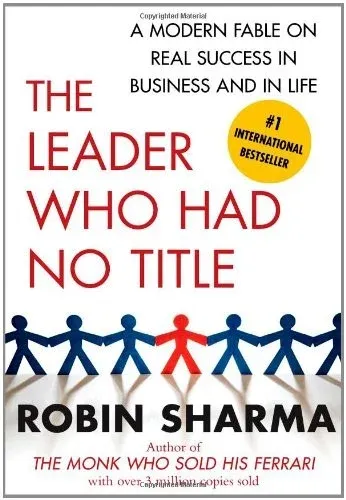
Robin Sharma’s The Leader Who Had No Title is a fable. Blake Davis, a young soldier hollowed out by war and the loss of his parents, drifts through a job at a New York bookstore until Tommy Flinn, a 77-year-old colleague who holds no rank and no title, becomes his teacher. Through a series of conversations, Blake learns four principles: leadership is available to everyone, turbulent times build leaders, relationships determine leadership strength, and leading others starts with leading yourself.
The book interests me for one reason that arrives early and matters throughout: none of these principles require formal authority, headcount, or budget. They describe how a person shows up inside whatever role they already hold, which is close to the constraint I work under. I influence a good deal of work without formally owning most of it.
Leadership is a choice, not a rank
Sharma’s first move is to remove the title from the definition of leadership. In this book, a leader is not someone with reports and a budget. A leader is someone who takes responsibility for outcomes within reach, acts with integrity when nobody is watching, and treats the work in front of them as worth doing well. Tommy’s version is direct: janitor, executive, or soldier, what distinguishes the person who leads is accountability and the quality of the work, not the label on the chair.
I take this as the book’s central reframe, and I find it useful precisely because it separates two things that organizations tend to merge: being accountable and being in charge. A title can assign accountability, but it does not create it. In technical work, some of the most consequential leadership I have seen came from engineers with no mandate, people who noticed a problem early, made it visible, and brought the right others to it.
The boundary matters as much as the principle. Owning a problem does not automatically mean owning its solution, and it certainly does not mean absorbing someone else’s work. Taken without that distinction, radical ownership slides into quietly carrying responsibilities that were never mine, which is the failure mode I described in Stop Acting as the Proxy. The same thesis arrives from a different direction in Don’t Wait, Lead Now, where Jim Lord shows through his own management career that leadership begins before a title grants it. Sharma gives the memorable story; Lord gives the lived cases. So my working version of the principle is narrower than Sharma’s: take responsibility for making the problem, its constraints, and its rightful owner explicit. Sometimes that means solving it. Sometimes it means refusing to.
Turbulent times build great leaders
The second principle arrives through Ty Boyd, a former slalom champion turned ski shop owner. His metaphor is the fall line. The move that makes a skier fast is the one that feels worst: leaning into the steepest part of the run instead of skidding away from it. Avoiding difficulty is how skiers stay safe, and it is also how they stay slow. Sharma’s transfer is that disruption, a failing system, a reorg, a problem with no clean answer, works the same way on people. Those who lean in develop resilience that comfortable periods never produce.
There is something true here, and something I would qualify. The true part is that a team permanently shielded from difficulty never builds the capacity to meet it. I have watched leaders absorb every shock before it reached their people, with good intentions, and produce teams that were calm and fragile at the same time. Naming a hard problem clearly and letting the team practice with it while I hold the frame has worked better than either hiding the problem or throwing people into it unsupported. The frame is doing real work here: an agreed outcome and a review point, the arrangement I described in Give Autonomy a Time Boundary, are what let difficulty be taken on without becoming exposure.
The qualification is that Sharma presents leaning into difficulty as close to unconditionally good, and it is not. Not every hard problem is a growth opportunity. Some difficulties should never have existed, and spending a team’s resilience on preventable crises is poor leadership disguised as character building. The skill the book underdescribes is selection: deciding which difficulties are worth taking on, which to escalate, and which to prevent outright. Leaning in is only half the job. The other half is judgment about where leaning in actually pays.
The deeper your relationships, the stronger your leadership
Jackson Chan, a former CEO of a multibillion-dollar tech company who has reinvented himself as a gardener, teaches the third principle from a rooftop garden. Plants cannot be forced; they respond to sustained care. His claim for business is parallel: companies succeed on the strength of the relationships behind them, not on tools or tactics, and those relationships are built through consistent attention rather than single grand gestures. His HUMAN acronym compresses the practice into five habits: being helpful, understanding, engaged, joyful, and nurturing.
My default as an engineer runs against this. When something keeps failing, my first instinct is to fix the system: tighten the process, add a check, improve the tooling. Jackson’s principle asks whether a person needs to be reached before a process needs to change. I have come to treat that as a genuine diagnostic question rather than a soft preference. The process fix is usually faster to execute, but attention invested in a person keeps working after I have moved on to something else. That makes people’s capacity one of the most durable effects of leadership, a point The Toyota Way reaches from a different direction when it warns that a leader who personally solves every important problem weakens the organization’s long-term capability.
The boundary here is scope. Caring for people does not mean every relationship needs equal depth, and it does not mean substituting personal attention for decisions that are properly structural. Some problems are genuinely process problems, and answering them with one more conversation is avoidance. The judgment is knowing which kind of problem is in front of me.
Leadership starts with you
The fourth principle comes from Jet Brisley, a massage therapist, in the book’s calmest setting. His argument: you cannot give others a discipline you do not hold yourself. He prescribes a protected morning hour for reading, journaling, and setting intention, alongside the slower work of emotional clarity, letting go of resentment, practicing gratitude, and keeping a clear view of what a life should amount to.
This is the principle I have most often neglected, and the one I am most skeptical of in its packaged form. A morning hour on a calendar is easy to perform and easy to mistake for the actual work. The emotional part, examining what I am carrying and whether it still serves the people around me, resists scheduling and cannot be displayed. I treat Jet’s principle as pointing at an ongoing practice rather than a routine: the maintenance is real, but the routine is only its container, and a container with nothing in it helps nobody.
What keeps me practicing it is a plain observation. The states I bring into a room, hurried, resentful, depleted, or steady, are exported to everyone in it. Protecting a short block at the start of the day for reading and thinking is the smallest version of this I have sustained. It resembles what Derek Draper argues in Create Space: the work that develops you needs protected room, because the urgent work will otherwise take all of it. And it holds for the same reason James Clear gives in Atomic Habits: behavior sustained by the environment outlasts behavior sustained by willpower, so the protected block matters more than the motivation that created it.
Where I read the book with care
The fable is the book’s strength and its limit. Because each principle arrives carried by Blake’s transformation, it is easy to absorb them as inspiration and miss where they need friction. Responsibility needs an owner, not just an ownerless sense of duty. Difficulty needs selection, not just courage. Self-mastery needs honest practice, not just a visible routine. Sharma gestures at some of this and skips the rest.
None of that makes the principles wrong. It makes them starting points that assume judgment the story does not fully supply. I read the book most usefully as a set of four prompts to apply with context, not as conclusions to adopt. The memorable story is what gets the principles into memory; the work of deciding what they mean in a specific team, on a specific week, remains mine.
How I Apply These Ideas
Four habits from the book have stayed in my daily work as a technical leader.
- Make the problem, its constraints, and its owner explicit. When something lands with me, I first ask whose decision it is. If it is mine, I own the outcome. If not, my contribution is visibility and context for the person who owns it, not quietly doing their work.
- Expose the team to useful difficulty, and prevent the rest. I surface hard problems early instead of smoothing them over, and I stay close while the team works through them. At the same time I treat preventable crises as failures of foresight, not training material, and I say so when that is what happened.
- Reach the person before changing the process. When something repeatedly fails, I pause to check whether attention to a person, clearer expectations, a direct conversation, would do more than another process adjustment. If the diagnosis is structural, I fix the structure and do not dress it up as a people problem.
- Protect a short block for thinking at the start of the day. Reading, reviewing what matters, and setting intention before the urgent work begins. I hold it as infrastructure rather than an option, because the weeks I skip it are the weeks my judgment gets thinnest.
Who Should Read This Book?
This book suits someone who leads or influences work without a formal mandate and wants an accessible, motivating entry point. It is short, the story carries the ideas, and the four principles are easy to hold in mind afterward.
It does not suit someone looking for a rigorous or evidence-based leadership framework. There is little research here and no model to implement mechanically. Read it for the reframe, then look elsewhere for mechanics.
Verdict
What remains after the critical reading is a narrower book than Sharma wrote and a more useful one than its platitudes suggest. I keep the reframe that accountability and authority are separable, the diagnostic question of person-before-process, and the discipline of protecting time to think. I set aside the story’s suggestion that difficulty is always instructive and that ownership has no edges. The book reinforced something my work had already been teaching me: the leaders I rely on most are rarely the ones with the most authority. They are the ones who show up steadily, choose their difficulties, and leave the people around them more capable than they found them.
When have you led something that mattered without the title to match? I would like to hear which part was hardest: the responsibility, the difficulty, or the patience.
Drop a comment below; I read every one.