On this page
- Space to think: reflection needs room
- Space to learn: growth mind-set overcomes fear
- Space to connect: emotions, check-ins and core pathogenic beliefs
- Space to relate: transparency, safety and stakeholder maps
- Space to do: plan first, then protect your focus
- Space to lead: the third space and delegation
- Space to be: purpose, balance and deathbed regrets
- Space to grow: opportunity cost and No. 1 Meetings
- Square breathing
- How I Apply These Ideas
- Verdict
Create Space
 Ammar Najjar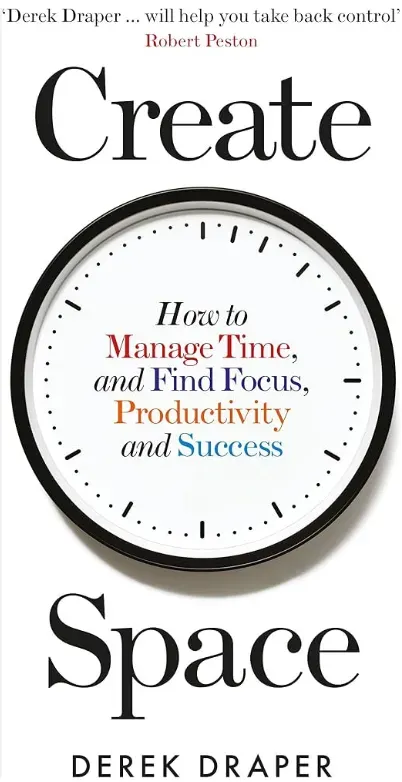
Derek Draper spent more than a decade coaching people at the very top of business, the FTSE 100 crowd, and Create Space (2018) distills all of that into one argument: the modern challenge isn’t to fill space, it’s to create it. For most of human history we’ve been exploring, expanding and filling the world around us. Now, for the first time, we’re overcrowded and overscheduled, and growth, improvement and development all depend on making room. Draper organizes the book around four domains, thinking, connecting, doing and being, and fills each one with tools from his real coaching cases, from structured reflection to a weekly meeting with yourself.
Space to think: reflection needs room
If you want to be good at what you do, you need self-awareness. Knowing your own strengths and weaknesses is a huge advantage, whether you’re an artist, a CFO or an administrative assistant. The key to knowing yourself is reflection, what people sometimes call “having a meaningful conversation with oneself.” Philosophers from Confucius to Socrates have championed it for centuries, but reflection has practical payoff too: it boosts your decision-making and cuts down mistakes. Before you act, think through the side effects and the alternatives; after you act, look at what went right and what went wrong. Do that regularly and you’ll make fewer mistakes, guaranteed.
But deep reflection needs room, and Draper means four kinds of room: temporal space (time), physical space (location), relational space (someone to bounce ideas off) and psychic space (being open to improvement and feeding your mind new, enlightening information). Creating all of that takes effort, and it connects to the identity work in Atomic Habits: the habit of stepping back before acting is the practice that makes the reflection sustainable. A study from Harvard University found that CEOs typically have less than 15 percent of their workweek available for solitary work. And if CEOs can’t carve out space to reflect, the rest of us don’t stand much of a chance.
It’s also not pleasant. Shutting out distractions is hard, and reflecting on your past might surface that you behaved foolishly in the last manager’s meeting, or treated your assistant inconsiderately. But the payoff is worth the discomfort: a study of commuters in the United Kingdom found that people who deliberately used their ride home to reflect on their day were happier and more productive than those who didn’t. So make the space.
Space to learn: growth mind-set overcomes fear
Staying open to learning goes hand in hand with having space to think. While reflection is a way of learning about yourself, you also need space to learn in the broader sense, and that starts with the right mind-set. Most of us operate with one of two: a fixed mind-set, the belief that learning stops at some point because the brain can only hold so much, or a growth mind-set, the belief that you can always learn more. The fixed mind-set has been scientifically debunked. Neuroscientist Dr. Michael Merzenich has shown that our brains are all “soft-wired” and capable of neuroplasticity: they change based on the input you feed them. A healthy brain is always capable of learning, which means we can grow and change, and that’s how we overcome our fears.
Take the fear of failure. In a 2015 study, one-third of all Americans reported fearing failure, with millennials the most susceptible. As widespread as it is, there’s a straightforward fix: fold failure into a growth mind-set and treat it as a learning opportunity. One of Draper’s clients, Rachel, worked for a global snack company. Her fear of failure ran so deep that she was prone to catastrophic thinking, believing that if she made the slightest mistake, everything would fall apart and she’d end up destitute. Draper worked with her for weeks, giving her space to reflect on where the fear came from. Together they discovered it traced back to her mother, who had been unemployed and homeless for a time. Somewhere inside, Rachel carried the unconscious fear that any mistake, or even asking for help, could send her down the same path. Over time she learned to think differently, and eventually she came to see that asking for help isn’t a sign of failure. Like reflection, creating space for learning takes effort: make time, find a good place, and line up helpful resources like a mentor.
Space to connect: emotions, check-ins and core pathogenic beliefs
The second kind of space you need is space to connect, and it starts with a quality connection to yourself. Like reflection, it’s about looking inward, but this time it’s about checking what’s going on in your body and your mind, which means observing your emotions. Strong emotions can hijack our actions and decisions if we’re not careful. With space to connect, you can check in regularly and make sure you’re the one in control, not your emotions.
One way to do this is the feeling and number check-in. Sit comfortably, take a few deep breaths and ask yourself, “How do I feel?” Once you name the feeling, rate its strength on a scale of one to ten. Then move to physical sensations, the tightness in your shoulders or chest, and give those a number too. If several emotions are competing for attention, imagine you’re an observer hovering above it all, not someone caught up in the middle. This is really just growing your emotional intelligence: how well you control your own emotions, keep relationships going and stay empathetic.
Do this consistently and you’ll be in a position to recognize what Draper calls your core pathogenic beliefs (CPBs), the assumptions that quietly keep your career stuck. Rachel’s CPB was that a mistake or a request for help would collapse her world. Other clients have carried beliefs like “I am unworthy of receiving love,” “I am unworthy of giving an opinion” or “everyone is untrustworthy, so there’s no sense in being nice.” Most CPBs grow out of past experiences, often from childhood, and getting to the bottom of them takes space to think and connect.
Space to relate: transparency, safety and stakeholder maps
Connecting to your own emotions is one thing; connecting to other people is another. For that you need space for sharing and relating, and it pays off in strong teams and meaningful relationships.
Draper worked with a team at a global beverage company that kept missing its targets. The leader, Beata, was cheerful and confident, but the team’s shared CPB soon became clear: they believed they always had to be nice to work well together. So problems, concerns, mistakes and conflicts were quietly buried and left to fester, and the team couldn’t grow or perform at its best. Once that belief was exposed and corrected, the team developed space to share. They practiced transparency, raising problems and mistakes and resolving them without fear of repercussion. That created real psychological safety, where members felt free to take risks and sometimes fail, which is part of learning and growing. Needless to say, they were soon back on track with renewed purpose and vitality.
Creating space to relate is another way to connect, and it’s invaluable for relationships. In their book Real: The Power of Authentic Relationships (2016), Duane and Catherine O’Kane share clinical studies suggesting that all of our problems trace back to relational issues. Low productivity and morale, high stress, anxiety and depression, whatever the issue, it’s usually linked to the people in your life. Making space to relate can fix that, and a stakeholder map shows you where to start. Put yourself in the middle of a piece of paper and draw lines to everyone in your life, from your partner and teammates to the security guard at work. Rate each relationship one to ten, ten being extremely deep and strong. Not every relationship needs to be a ten, but the map makes it obvious which ones need work. It’s a lot of effort, but the better your relationships, the better you’ll feel, and the better you’ll lead.
Space to do: plan first, then protect your focus
Some people love spontaneity, but when it comes to being productive, planning comes first. Skip the planning and you can end up like Red Technologies, a startup run by two brothers: Tom, the tech geek, and Darren, the charismatic one who handled the business side. The company started strong but grew messier and less coherent. A big part of the problem was Darren. He refused to set clear goals, so his staff never knew what to prioritize. Meetings ran without agendas, and everyone deferred to him as he pulled solutions out of thin air before racing off to the next emergency.
Planning properly means two things. First, a clear goal: what needs to be done. Second, a clear plan for reaching it: how it should be done. When Draper decided to write Create Space, he knew he’d need about 120,000 words, so he built a year-long plan: 10,000 words per month, 2,500 per week, 500 per day. Some days he fell short, others he overshot. What mattered was that the plan kept him focused on delivering. And flexibility has a place: build regular meetings into a one- to three-year plan to reassess your goals and vision.
There’s a difference between being productive and being busy. Darren loved “saving the day,” constantly putting out fires instead of planning and organizing. It made him feel useful and needed, and it certainly kept him busy. But he wasn’t delivering. He was just reacting to the chaos he’d created himself.
Distraction is the other enemy of space to do. Studies show CEOs get about 28 minutes per day of uninterrupted work, the average worker has an eight-second attention span, and every interruption costs ten minutes to get back to your previous level of concentration. Distractions aren’t just productivity killers; they’re a source of dopamine, the addictive neurochemical your brain releases for pleasure. Every email and text triggers a little hit, which is why millennials are likely to open an incoming email within 90 seconds. The fix is environmental: hide your phone, keep notifications out of sight, and in open-plan offices put on headphones or move to a conference room or café, anywhere you can focus.
To prioritize well, Draper offers the 4D Rule: Do, Defer, Delegate or Drop. Set the bar high for Do, only tasks that are essential, urgent and can’t be done by anyone else, and schedule the most difficult one first each day so you can’t procrastinate around it. Things that can’t be done right now go on the Defer list, anything that doesn’t need your personal touch goes to Delegate, and anything that isn’t essential gets Dropped. Come back to the deferred items regularly and reclassify them as Do or Drop when you can.
Space to lead: the third space and delegation
Leading well involves a unique kind of space: “the third space,” created whenever two people work together. When Yulia came to Draper for coaching, she’d just been promoted to CEO of an organization where she managed other leaders. She was brilliant at stepping into a situation and doing what needed to be done, but she made a common mistake in the third space: she took over. She provided the solution herself and left no room for the other person to solve the problem. Some people are grateful when a leader does that, but it disempowers the ones who want to learn and grow, because it sends a clear signal that their boss doesn’t trust them to rise to the occasion.
Lao Tzu put it best: “A leader is best when people barely know he exists, when his work is done, his aim fulfilled, they will say: we did it themselves.” Leadership isn’t about you; it’s about them. That is the philosophy behind most of my technical leadership writing: step back, make the outcome explicit, and let the team carry the decision. So instead of arriving with an answer, ask yourself what questions would let the other person discover the right answers on their own.
Delegation is the other great tool of empowerment, and a lot of well-meaning leaders feel guilty about it, as if they’re dumping hard work on someone else. They think they’re being nice by not delegating, but they could just as easily be communicating that they don’t trust the person to do a good job. Reframe delegation as a way to help people grow their skills, and as a sign of trust. Ask what tasks would challenge them just enough to push the edges of their skills, and which ones align with their personal career goals. When you assign something, be clear about what needs to be done and what the outcome should look like, but resist telling them how to do it. They might come up with something better than your way.
Space to be: purpose, balance and deathbed regrets
When you were in school, what did you love to do? Are you still doing it? If not, what happened? Asking yourself these questions is a big step toward creating space to be. Draper’s client Oscar was the CIO of a major bank, and miserable. What he really wanted was to farm. His fondest memories were of growing up on his family’s farm, tending the land and the animals. But the family sold the farm, Oscar went to college and eventually ended up stuck inside an office all day. After coaching helped him reconnect with his true passion, he resigned so quickly that it caused a minor emergency at the bank. It was the right thing to do.
A lot of us end up in jobs that are “sensible” or that meet someone else’s expectations. So many, in fact, that it’s one of the most common deathbed regrets: people wish they’d lived life as they truly wanted, not as someone else expected them to. Keeping death in mind helps you avoid that. Ask yourself: if you had six months to live, what would you be doing?
Work doesn’t have to be a hellish experience. It gets difficult from time to time, sure, but in general it should feel good and satisfying. If it doesn’t, you might be doing the wrong job, or you need a better work-life balance. Trevone, for example, assumed work was supposed to be a chore that made you feel awful. When he met Draper, he’d just been hospitalized for exhaustion, panic attacks and depressive bouts, and he expected help getting back to the lifestyle that had put him there. What he actually needed was to delegate more, get more sleep and stop spending 80 percent of his life at work. Most overworked people will find that working less and sleeping more sets them up for sustainable success instead of burnout.
Space to grow: opportunity cost and No. 1 Meetings
The last space is space to grow: setting yourself up for your ideal future. Growth, like life, is full of hard choices, and choosing one thing always means saying no to something else. That’s “opportunity cost,” and staying aware of it is essential. Take Almantas. He had the chance to move closer to his mentor and position himself for his dream job, but it meant relocating to a new country, where his wife would have to adjust to a very different culture and his kids would have to learn a new language. The cost seemed high. He took the position anyway, his boss stuck with him through a bumpy transition year, and afterward he was crushing his quarterly targets just like before. Relocating, taking a pay cut, going back to school, these are all common opportunity costs, and they feel like a burden. But they’re a small price if they bring you closer to your dream and your purpose.
Finally, while you’re making plans and setting goals, schedule regular No. 1 Meetings, meetings with yourself. Draper suggests a weekly No. 1 Meeting built around three objectives: setting a strategy, adopting a growth mind-set and raising productivity. Run it on questions like: How is my strategy progressing? Are the goals realistic? What resources could help me stay on track? Are there distractions keeping me from my goals, and how can I avoid them? And remember, life is rarely perfect. Often you have to settle for good enough, so allow yourself some mistakes and trust that your hard work will pay off.
Square breathing
One practical tip worth stealing: when you need to calm down and focus, try square breathing. It’s used by yoga practitioners, Navy SEALs and executives alike, and it’s called square because of its four by four structure. Breathe in and count to four, hold for four seconds, breathe out for four seconds, pause for four seconds, then start the cycle again.
How I Apply These Ideas
-
Guard the solitary minutes: The Harvard finding that CEOs get less than 15 percent of their week for solitary work hit close to home. In a job full of meetings, I now protect the first hour of the day for deep work before I open email or Slack. That protected hour, more than the 28 minutes per day the book claims most CEOs get, is the highest-leverage part of my schedule.
-
No. 1 Meetings: I turned Draper’s weekly meeting with yourself into a standing Friday review. I keep the notes in Obsidian and ask the book’s questions: How is my strategy progressing? Are the goals realistic? What distracted me this week, and how do I avoid it next week? Fifteen minutes on Friday saves me hours of context-switching on Monday.
-
The 4D Rule as a backlog triage: Every task that lands in my inbox gets a quick Do, Defer, Delegate or Drop decision, and it all lives in Obsidian as my to-do list. The hardest task goes first on my daily schedule, exactly as Draper suggests, so I can’t procrastinate around it. Drop has been the most liberating category; most things just aren’t essential, and saying so out loud keeps the list honest. And whenever I de-prioritize a task, I communicate with the people who are affected by or interested in that task or topic, so a change in priority never silently surprises anyone waiting on it.
-
Delegation as growth, not dumping: The reframe that delegation is a sign of trust, not an imposition, changed how I hand off work to my team. I track delegation tasks in Obsidian, assign work that stretches people just past their current skill level, set clear expectations on the what and the outcome, and deliberately avoid prescribing the how. More than once the result was a better approach than mine.
-
Delegation as exposure: The biggest shift for me was extending delegation beyond tasks to context. I actively pull colleagues into discussions, rounds and other activities I’m involved in outside their team, so they see how decisions actually get made beyond their internal team interactions and processes. It expands their horizon in a way no amount of task delegation can, because they start understanding the wider context that shapes their own work.
-
Relational space: The stakeholder map idea, rating relationships one to ten, feels clinical but it works. I applied a lightweight version to my team: identifying which working relationships were draining energy and which deserved more attention. The book’s claim that most problems trace back to relational issues has held up in practice more often than I expected.
-
Square breathing before hard conversations: When a difficult 1:1 or a tense incident review is coming up, I do one cycle of square breathing first. Four seconds in, four held, four out, four paused. It’s a small ritual, but it reliably drops my shoulders out of fight-or-flight before I walk in.
Verdict
Create Space is at its best where Draper’s own expertise lives: real coaching cases that make every tool concrete. The four-domain structure, thinking, connecting, doing and being, is simple enough to hold in your head and broad enough to cover career, relationships and purpose, and the practical techniques, from the 4D Rule to No. 1 Meetings, are ready to use the same day you read them. It’s written for leaders and professionals who feel perpetually busy and slightly overwhelmed, people who suspect the answer isn’t doing more but making room. It’s dense with case studies and occasionally light on depth, but as a practical framework for reclaiming focus and direction, it’s well worth your time.
Have you felt the need to create space rather than fill it?
Drop a comment below; I read every one.