On this page
Don’t Wait, Lead Now
 Ammar Najjar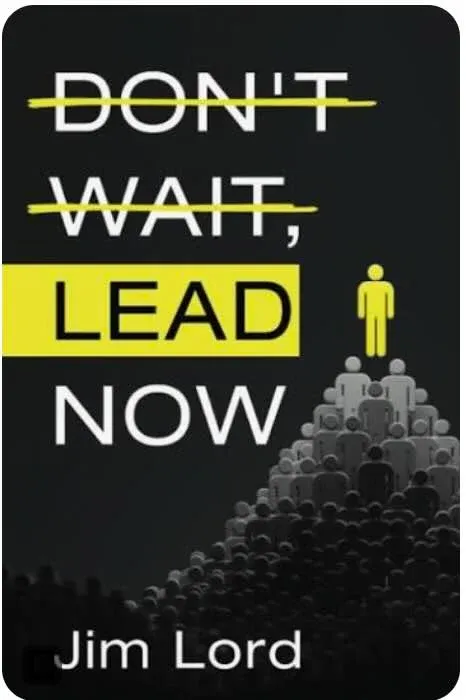
Jim Lord’s Don’t Wait, Lead Now argues that leadership can begin before someone has a formal title or an ideal opportunity. Drawing on more than thirty years in management and executive roles, Lord tells stories about people who influenced his career, decisions that tested his judgment, and small actions that had a lasting effect.
The book covers familiar ground: take initiative, communicate sincerely, hold people accountable, and help them grow. Its value lies in the situations behind that advice. A promotion with better pay can still be the wrong move. A brief handwritten note can mean more than a standard recognition message. Handing someone responsibility still requires attention to what happens next.
Those situations connect with the shift I am making from solving technical problems myself toward helping others make and carry decisions. The challenge is to apply Lord’s ideas with judgment. Initiative can create a dependency if I take on too much. Accountability can become control if I stay involved in every detail.
Lead from where you are
Lord left high school during his junior year to work and help support his family. He returned the following year, graduated as an honor student, and later earned a degree from Providence College. He went on to build a career that took him from frontline work into executive leadership.
His story gives the book’s title a concrete meaning. The first responsibilities he describes did not come with a management position. They involved keeping a promise, doing the work in front of him, and finding a way to continue his education while helping his family.
Later in his career, he built an automated solution for a major client without being asked. The initiative addressed a real need and made his contribution visible. Lord’s point is that waiting for a role to grant permission can mean overlooking work you are already able to do.
I find that habit useful, provided I also ask who should own the work. Sometimes taking responsibility means making a problem visible, bringing the right people together, or supplying context that helps someone else move it forward.
Develop people whose work outlasts yours
At a retirement celebration for Bob, an executive who had supported Lord early in his career, Lord noticed two speeches. One speaker spoke personally and moved the room. Another read from prepared notes and seemed distant, despite having known Bob for years. Lord took from this the importance of speaking sincerely.
As an executive, Lord also paid attention to recognition in a personal form: handwritten notes of congratulation for top sales associates, in place of the standard templated recognition. In an environment of uniform messages, the personal note stood out and was remembered.
What stayed with me more was Bob’s influence on the people in the room. He had taken a chance on Lord, and Lord could see how that decision had affected careers beyond his own. The celebration showed what years of developing people had produced.
Lord returns to this idea when he discusses hiring and promotion. He urges leaders to look beyond polished credentials and recognize drive, adaptability, and potential. A leader’s contribution becomes visible in what people are able to do with the opportunities and support they receive.
For a technical leader, this is a demanding measure. Solving a difficult problem personally may produce a quick result. Helping a colleague understand it, make a sound decision, and explain that decision to others takes a different kind of effort. Over time, it changes how much the team can do without depending on one person. I read Liker’s The Toyota Way in the same spirit: a leader develops people who can understand and solve problems, rather than becoming the person every problem is routed through.
Choose the conditions in which you can lead well
After many years with one firm, Lord was offered a senior position in another business unit with a substantial pay increase. He had concerns about the unit president’s leadership style and sought advice from someone he trusted. He declined the role.
The business unit he stayed in went on to do well, while the other encountered serious problems. Knowing those outcomes makes the decision look clear in retrospect. At the time, Lord had to judge the opportunity with incomplete information.
That is what makes the story useful. A title and salary describe only part of a role. The people who set priorities, respond to problems, and shape how employees are treated affect what a leader can actually do. Lord had to decide whether the position would give him conditions in which he could lead according to his values.
The same question appears within an existing role. When responsibility crosses team or organizational boundaries, I need to understand which decisions are mine, where I can influence an outcome, and when I should bring in the person who has the authority to decide. Clarity on those boundaries helps me remain responsible for my part without taking ownership of someone else’s.
Stay close to the actual work
Lord uses the phrase “Inspect what you expect” to describe the attention required after setting an expectation or delegating work. He argues that leaders need to hear from clients and frontline employees because reports moving upward can leave out important parts of their experience. I connect this to How Google Works, which makes a case for transparency and an open flow of information. To me that supports the same instinct: stay close enough to the work to hear what the reports miss.
He also advocates feedback that flows across an organization, including from employees to managers and between teams. People closest to a problem may recognize it early, yet hesitate to speak because they do not consider it their place. A leader who wants to understand what is happening has to make room for those observations.
I read this as a call for regular contact with the work and the people doing it. Agreeing on an outcome, asking what has been learned, and reviewing the result give a team room to act while keeping the leader informed enough to offer support or intervene when needed.
Where I read the advice with care
Lord’s directness is part of the book’s appeal. It also makes some of his shorter rules easy to apply too broadly. “One more push-up” encourages an extra effort that might distinguish a person’s work. Repeated without regard to capacity, it could make extra effort the expected answer to a workload problem.
His advice to “hire slow, fire fast” addresses the damage caused when managers avoid a persistent performance issue. A personnel decision still calls for clear expectations, direct feedback, support, and a fair assessment of what has happened. The memorable phrase cannot supply those steps.
I find the book most useful as a collection of situations to think through. Lord shows what he chose and why. The reader has to examine the conditions before carrying the choice into another team.
How I Apply These Ideas
Lord’s stories give me several ways to examine my day-to-day work as a technical and engineering leader.
-
Take initiative by creating clarity: When a discussion spans several teams, what I have found most useful is making the problem, the constraints, and who owns the decision explicit. Gathering information or bringing people into the same conversation lets work move forward without my becoming the owner of every open question.
-
Give others access to context: A decision summary tells colleagues what was agreed. Where it makes sense, I also invite them into the discussions that shape the decision, so they can hear the trade-offs firsthand and build relationships across the team. That is the point I made in ownership starting before the decision: a summary carries the decision, not the judgment behind it.
-
Hand over meaningful responsibility: When I know a system or problem well, my instinct is to keep working on it. What has worked for me is sharing the context I have, agreeing on the desired outcome, and letting a colleague choose how to proceed. My part becomes staying available for support, while the work stays with them.
-
Keep the underlying concern in view: Engineering discussions sometimes begin with a proposed practice or solution. I have found it useful to ask what problem prompted the proposal and what improvement people hope to see. The group can then consider other approaches while still taking the original concern seriously, separating the practice from the problem.
-
Review outcomes without reclaiming decisions: When a team chooses an approach I would not have chosen, I have found it useful to give them room to try it. I learned from one such experience that we should have agreed on the expected outcome and review point before the team started.
-
Stay within my role while speaking up: Some decisions affect people beyond my team or sit outside my authority. I can gather facts, explain the implications I see, and challenge a proposal when I need to. If the decision is not mine to make, I bring those concerns to the person responsible and let them decide, while staying available if they want more context.
These applications share a tension I encounter often: I want people to have enough space to develop their judgment, and I remain responsible for providing direction, context, and follow-through. Lord’s book gives me useful questions to ask as I work through that tension, and I have written about one of them separately, on giving autonomy a time boundary.
My Top 5 Takeaways
- Leadership can begin before a title or a formal opportunity.
- Developing people’s judgment has a longer effect than solving a problem for them.
- The people and decision boundaries around a role matter as much as the title and pay.
- Inspecting what you expect, and staying close to the work, is how a leader keeps enough information to help.
- The book’s most memorable rules need the conditions that produced them before they travel to another team.
Who Should Read This Book?
Don’t Wait, Lead Now is a good fit for someone beginning to lead people or taking on more responsibility without a neat change in title. Its stories also give experienced managers situations against which to examine their habits.
Readers looking for a research-based framework will find relatively little of that here. Lord’s approach is personal and story-driven. It works best when you pause at a decision he describes and ask what he knew at the time, what mattered to him, and how you would act under your own circumstances.
Verdict
Don’t Wait, Lead Now is a collection of situations rather than a system. Its stories give familiar advice practical weight, whether it is Bob investing in someone’s potential, Lord declining a promotion, or the insistence on hearing what people experience beyond a management report. The book’s shorter rules, like one more push-up and hire slow fire fast, still require judgment before they are applied elsewhere, since the right way to apply them depends on the people and circumstances involved.
How do you decide when to step back in after handing over a decision?