On this page
- Lesson 1: The Rich Don’t Work for Money
- Lesson 2: Why Teach Financial Literacy?
- Lesson 3: Mind Your Own Business
- The cash flow patterns of the poor, the middle class, and the rich
- Lesson 4: The History of Taxes and the Power of Corporations
- Lesson 5: The Rich Invent Money
- Lesson 6: Work to Learn, Don’t Work for Money
- The five obstacles to wealth creation
- My opinion on this book
- What I would take away
- What I would be cautious about
- Vague and Non-Actionable
- Reckless Business Advice
- Dangerous Debt and Legal Boundaries
- The Business of Expensive Seminars
- US-Centric Legal Frameworks
- My advice on how to read it
- How I Apply These Ideas in My Real Life
- Verdict
Rich Dad Poor Dad
 Ammar Najjar · Posted on August 20, 2026 · 16 min readself-improvement
Rich Dad Poor Dad by Robert T. Kiyosaki and Sharon L. Lechter is one of the best-selling personal finance books ever written, translated into 51 languages and part of a series that has sold more than 30 million copies worldwide. The book tells the story of two father figures in Kiyosaki’s life: his own highly educated but financially struggling real father, and his best friend Mike’s uneducated but wealthy father, who became his surrogate financial mentor and died as one of the richest men in Hawaii. From these two contrasting examples, Kiyosaki builds six lessons about money, assets, and the mindset that separates the wealthy from everyone else.
Quick Take: Read it for the mindset shift, not the financial tactics. The asset/liability reframe and “Rat Race” escape philosophy are genuinely valuable. But the specific advice is vague, US-centric, and sometimes reckless. Treat it as motivation, not a manual.
Lesson 1: The Rich Don’t Work for Money
In 1956, when Kiyosaki was 9 years old, his wealthy friend Jimmy invited mutual friends to his parents’ beach house but excluded Robert because he was poor. That evening, Kiyosaki asked his father how to get rich. The answer was a smile and a vague “use your head, son.” Wanting something concrete, Kiyosaki arranged to meet his best friend Mike’s father, a man who owned several warehouses, a construction company, a chain of stores, and three restaurants. The offer was simple: “You work for me, and I’ll teach you.”
Kiyosaki accepted, but after three weeks of earning 10 cents an hour and learning nothing he could see, he wanted to quit. His rich dad’s response became the first lesson: life pushes everybody around, but while the poor give up or blame others, the rich use the pushing to change and grow. “Stop blaming me and thinking I’m the problem. If you think I’m the problem, then you have to change me. If you realize that you’re the problem, then you can change yourself, learn something, and grow wiser.”
Kiyosaki argues that many people accept poorly paid work because they prefer the security of a regular paycheck to the risk of pursuing a different path. In his view, fear of not being able to pay the bills keeps many people dependent on employment. In Kiyosaki’s framing, the rich build wealth by making money work for them rather than relying solely on earned income.
Lesson 2: Why Teach Financial Literacy?
Time is a limited resource: Kiyosaki argues that you will never become a millionaire getting paid by the hour. But wealth is not about how much you make; it is about how much you keep. Kiyosaki uses this idea to explain why even professional athletes or lottery winners can run into financial trouble despite having earned or received large amounts of money. Money alone does not solve financial problems and can even reinforce poor financial habits. If your internal “cash flow pattern” is “spend everything you get,” an increase in income will simply produce an increase in spending.
The missing subject, in Kiyosaki’s view, is financial aptitude: “what you do with the money once you make it, how to keep people from taking it from you, how to keep it longer, and how to make that money work hard for you.” Financial literacy needs to be taught. And its core rule is simple enough for a school lesson: “Know the difference between an asset and a liability, and buy assets.”
Lesson 3: Mind Your Own Business
An asset puts money in your pocket. A liability takes money out. The rich acquire assets; the poor and middle class acquire liabilities they mistake for assets; the poorest have only expenses. If you want to build wealth, focus on your asset column, not your income statement.
Kiyosaki breaks real assets into seven categories:
- Businesses that do not require your presence (if you have to work there, it’s a job, not a business).
- Stocks.
- Bonds.
- Income-generating real estate.
- Notes (IOUs).
- Royalties from intellectual property: music, scripts, patents.
- Anything else that has value, produces income or appreciates, and has a ready market.
“Minding your own business” means building and defending this asset column: once a dollar goes in, never let it come out. Money works 24 hours a day and can work for generations.
The cash flow patterns of the poor, the middle class, and the rich
The assets-versus-liabilities distinction becomes concrete when you look at how each class moves money relative to its income and balance sheets.
The poor pattern: Income comes strictly from a paycheck and flows immediately out to cover basic living expenses: rent, food, clothing, taxes. Few assets are built because most income flows directly toward recurring expenses.
The middle class pattern: Income comes from a paycheck, but as earnings increase, the individual acquires liabilities disguised as assets: a mortgage-financed primary residence, upgraded vehicles, and personal loans. These liabilities generate continuous secondary expenses (property taxes, maintenance, interest) that trap the individual in high fixed overhead.
The rich pattern: Income is primarily generated by an asset portfolio: rental cash flow, stock dividends, business net revenue, royalties. This asset column self-funds both personal expenses and the purchase of additional assets, which makes earned salary secondary or unnecessary.
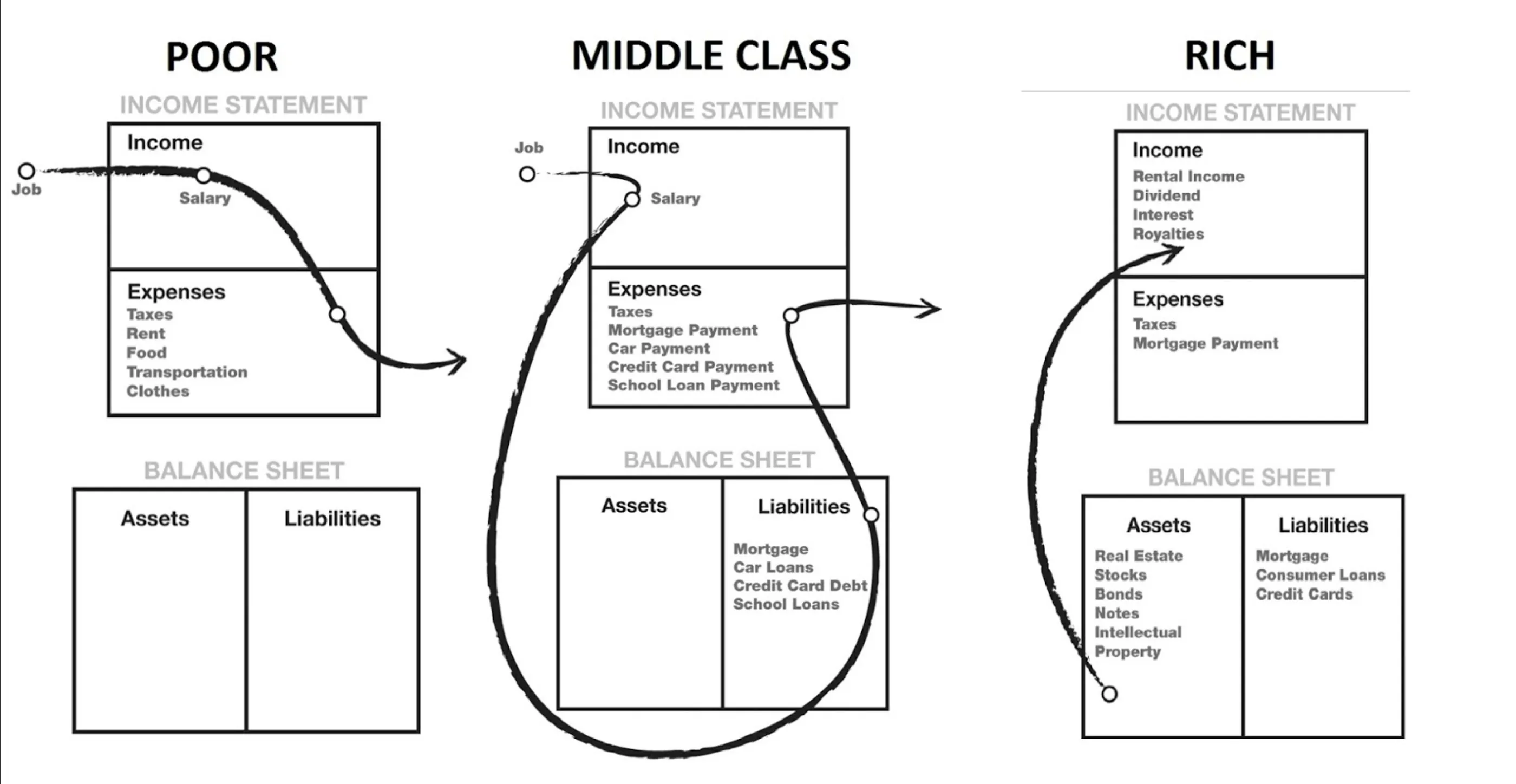
Cash flow differences across classes. Source: SingSaver
Lesson 4: The History of Taxes and the Power of Corporations
According to Kiyosaki, the difference between how employees and business owners handle taxes is one of the most important concepts in the book, though it is rooted in US tax law and does not translate directly to every jurisdiction. Kiyosaki presents the distinction in simplified terms: employees pay taxes on their income and cover living expenses from what remains, while businesses can deduct certain legitimate operating expenses before taxable profit is calculated. This framing is central to his argument about why financial education matters.
The structural difference, as Kiyosaki presents it:
[ Employee Flow ]
Earn Income -> Taxed Immediately -> Live on What Remains

[ Corporate Flow ]
Earn Income -> Pay Business Expenses -> Taxed on Remaining Profit
Kiyosaki argues that by owning a corporation, investors write off pre-tax expenses, such as business travel, equipment, transportation, and operations, before taxable income is calculated, while taxes are already deducted from employee income before private living expenses are paid. This is how he frames the structural advantage of corporate ownership.
Kiyosaki frames the underlying competence here as financial intelligence: “the synergy of many skills and talents,” built from four technical areas:
- Accounting: the ability to read financial numbers, income statements, and balance sheets. Without financial literacy, you cannot evaluate the strength or weakness of a business or investment opportunity.
- Investing: the science of “money making money,” with room for creativity alongside formulas. It means understanding strategies and market dynamics to identify asymmetric risk-to-reward opportunities.
- Understanding markets: the science of supply and demand, distinguishing technical (emotion-driven) from fundamental (economic) aspects of investments.
- Law: awareness of state and federal regulations, tax advantages, and liability protection. Corporate structures minimize tax drag and shield assets against lawsuits.
Lesson 5: The Rich Invent Money
No asset is more powerful than a trained mind. With financial intelligence, you can create wealth; without it, you accumulate bills. The practical implication is simple: you have two paths. Kiyosaki deliberately frames the first path in stark terms: work hard, pay a substantial portion of your income in taxes, and save what remains. The second path is to develop your financial intelligence and put the asset column to work.
Millions choose the first path because they are afraid to fail and want to avoid loss at all costs. “People who avoid failure also avoid success,” Kiyosaki writes. In practice, the bold get ahead. “Secure” and “smart” investments, in Kiyosaki’s view, rarely generate real wealth; opportunity lies in what others have missed. The skill is in raising money, organizing smart people, and investing in ideas that most people overlook.
Lesson 6: Work to Learn, Don’t Work for Money
“Job security meant everything to my educated dad,” Kiyosaki recalls. “Learning meant everything to my rich dad.” He eventually concluded that “job” stands for “just over broke” and that working solely for money is a trap. His own path included deliberately leaving a secure army career to join Xerox, specifically to be trained in sales and marketing, skills he knew he needed. The gamble paid off: he became the owner of an investment company and retired at the age of 47 as a multimillionaire.
Beyond managing cash flow and investment systems, Kiyosaki identifies managing people as the third critical skill. Working to learn, rather than to earn, means choosing jobs and experiences that build the competencies you need to build and run assets, not just income. This philosophy echoes How Google Works, where Schmidt and Rosenberg argue that the best career moves are learning-driven, not title-driven: surround yourself with people smarter than you, and treat every role as an investment in your future capabilities.
The five obstacles to wealth creation
Even financially educated people struggle to reach financial independence, Kiyosaki argues, because five behavioral blocks get in the way.
- Fear: the fear of losing money. Everyone fears losing money; the difference lies in how loss is handled. In Kiyosaki’s framing, the wealthy manage risk rather than simply avoiding it. Kahneman’s prospect theory helps explain part of this behavior: people tend to weigh losses more heavily than comparable gains, which can contribute to excessive risk aversion. For a deeper dive into the cognitive biases behind financial fear, see my notes on Thinking, Fast and Slow.
- Cynicism: noise and self-doubt. Cynics analyze instead of act, letting external opinions or fear of market crashes prevent them from seizing obvious opportunities.
- Laziness: specifically “busy laziness,” staying occupied with routine work to avoid confronting important financial realities or long-term financial planning.
- Bad habits: paying everyone else before yourself. Kiyosaki advocates “paying yourself first”: allocate money to your asset column first, then let the pressure of unpaid bills drive creative ways to generate extra income.
- Arrogance: believing that what you do not know is unimportant. Arrogance creates financial blind spots and unnecessary losses.
My opinion on this book
After reading Rich Dad Poor Dad, here is my honest advice for anyone picking it up.
What I would take away
The book’s real value is psychological, not tactical. Three ideas stuck with me:
- The asset/liability reframe changed how I think about property: Kiyosaki challenges the conventional wisdom that a primary home is a family’s greatest investment. Instead, he labels it a liability because it continuously drains cash through mortgages, taxes, and maintenance. I found this framing genuinely useful; it pushed me to think about cash flow rather than net worth.
- The 10 cents per hour story is a powerful allegory: Nine-year-old Robert works at a grocery store for 10 cents an hour, then rejects a raise to learn how the business actually works. The lesson is clear: stop trading time for money, start spotting opportunities that others overlook. I have returned to this story several times when evaluating career decisions.
- The standard formula deserves to be questioned: The book pushes back against “go to school, get a safe job, and buy a house.” Whether or not you agree with every claim, the challenge to conventional thinking is the book’s most valuable output. Bill Draper makes the same argument from a different angle in Create Space: the deathbed regrets he documents all come from people who followed the conventional path and woke up too late to question it.
What I would be cautious about
I would not follow the book’s financial advice literally. Here is why:
Vague and Non-Actionable
- No operational blueprints: Kiyosaki tells you what to do without explaining how. He instructs readers to “buy distressed real estate” and “find undervalued stocks,” but provides zero formulas for calculating cash-on-cash return, evaluating cap rates, or performing due diligence. The rich dad’s lessons (like refusing to pay a salary) are abstract anecdotes, not frameworks an adult can replicate in the real world.
- Repetitive structure: Core maxims like “the rich don’t work for money” and “buy assets, not liabilities” are repeated endlessly without adding mechanical depth, creating the illusion of a comprehensive manual while remaining surface-level. Multiple chapters recycle the same childhood anecdotes instead of introducing new financial concepts.
Reckless Business Advice
- Paralysis by omission: The book pressures you to leave employment and launch a business, but never defines what a business actually is. It demands that a beginner “start a business” without explaining product-market fit, cash flow management, operations, or regulatory compliance. The result is anxiety and paralysis: readers are told to take a massive leap into a domain the author never bothers to explain. The concrete examples are wildly simplistic (like running a comic book library as a child), offering zero practical understanding of how a modern business generates value, manages overhead, or survives initial failure.
Dangerous Debt and Legal Boundaries
- Reckless leverage: Kiyosaki treats debt as an unqualified tool for wealth building while dismissing financial safety nets. He encourages maxing out leverage to acquire assets, which leaves you vulnerable to interest rate spikes, market crashes, or tenant defaults. His personal philosophy, “if I owe the bank a billion dollars and go broke, it’s the bank’s problem,” illustrates a reckless attitude that can devastate an everyday investor.
- Information advantages: Some of his examples involving informational advantages in stock trading deserve scrutiny. The important boundary is between legitimate research and the use of material non-public information.
The Business of Expensive Seminars
- Commercialization: The book also serves as an entry point into an expensive seminar ecosystem. The 2012 bankruptcy of Rich Global LLC, following a judgment over unpaid royalties, also complicates the financial image surrounding Kiyosaki’s business ventures.
US-Centric Legal Frameworks
- Jurisdiction-specific advice: As a reader from Germany, I found that many of the legal structures, tax advantages, and corporate frameworks Kiyosaki describes do not apply universally. The corporate tax flow, for example, is built on US tax law. Real estate strategies, depreciation rules, and liability protections vary significantly from country to country. If you are reading this outside the US, you need to verify whether any specific tactic is even legal or relevant in your jurisdiction before attempting it.
My advice on how to read it
Rich Dad Poor Dad is a motivational philosophy, not a financial manual. I would suggest treating it that way:
- Read it for the mindset shift: The book’s strength is helping you build financial ambition and recognize the importance of passive income, cash flow, and financial literacy. The psychological patterns Kiyosaki describes (loss aversion, status-seeking, fear of failure) are the same cognitive biases that Thinking, Fast and Slow explains in rigorous detail.
- Do not stop there: Once the paradigm shift happens, move on to data-driven, evidence-based literature that teaches the technical mechanics of actual wealth building.
- Separate the signal from the noise: The core ideas (assets generate wealth, financial education matters) are useful and worth considering. The specific tactics (heavy leverage, speculative stock picking, vague business advice) deserve much more caution and independent verification.
How I Apply These Ideas in My Real Life
While I reject the book’s risky tactical advice, the mindset shift influenced how I approach my career and personal finances:
- “Work to learn” in my career: Instead of staying strictly in my technical comfort zone as a software architect, I took on a role as a chapter lead to intentionally develop my leadership and management skills. I treated this career step as a long-term investment in acquiring broader organizational capabilities rather than just chasing a title.
- A starting line, not a playbook: I never took Kiyosaki’s financial claims or advice at face value. The book served merely as an opening spark that motivated me to invest real time into studying actual financial statements, investing mechanics, corporate law, and business fundamentals through more grounded resources (such as The Personal MBA and JL Collins’ work).
- Automating “pay yourself first”: On payday, an automated transfer immediately routes a fixed percentage of my income into low-cost index funds before I touch money for variable monthly expenses. This is the same systems-over-willpower principle that Atomic Habits describes: make the desired behavior the default, allowing consistent behavior to shape identity over time.
- Distinguishing utility from investments: I primarily treat cars, personal technology, and my primary residence as lifestyle expenses rather than automatically considering them investments. Framing them this way prevents overspending under the false assumption that I am buying “investments.”
- Focusing on returns from assets rather than salary alone: I track a simple metric comparing my fixed monthly expenses with the returns generated by my portfolio, keeping my ultimate focus on building cash-flowing assets rather than solely relying on active paychecks. I built a Portfolio Tracker precisely for this: a browser-first tool that keeps all data local and lets me monitor my asset allocation without depending on any third-party service.
Verdict
Rich Dad Poor Dad is a global phenomenon and one of the best-known and most discussed books on personal finance. Its core argument, that financial education should begin early and center on acquiring assets rather than chasing income, remains as relevant as when it was first published. The book is short on concrete investment mechanics and long on mindset, which is simultaneously its main strength (accessible, memorable, motivating) and its main limitation (those looking for specific investment guidance will need other books). Best suited to anyone who has never thought systematically about the difference between assets and liabilities, or who suspects their relationship with money was shaped more by fear than by knowledge. Read it for the paradigm shift, but do not stop there; the real education begins when you close the book and pick up something more rigorous.
Have you read Rich Dad Poor Dad? Did the asset/liability reframe change how you think about money?
Drop a comment below; I read every one.