On this page
How Google Works
 Ammar Najjar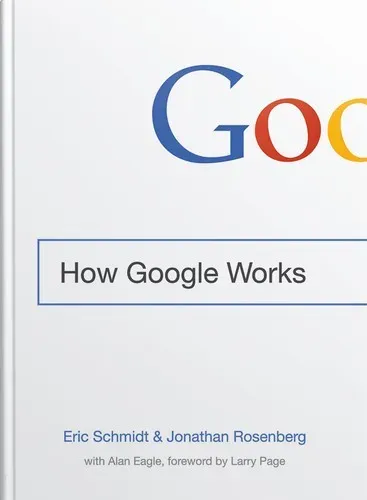
Google was founded in 1998 by two Stanford PhD students, Larry Page and Sergey Brin, with no formal business experience and no MBA playbook to follow. This book is the inside account of what happened next, written by Eric Schmidt, Google’s CEO from 2001 to 2011, and Jonathan Rosenberg, its longtime head of products. Their argument is blunt: the old command-and-control management model cannot survive the speed of modern innovation. The only sustainable path is to build a company around “smart creatives”, obsessive hiring, and a culture that treats engineers as the core of every decision. If you have ever wondered why Google works the way it does, this is the explanation from the people who made it.
Users before revenue
Google was not founded with profit as its primary objective. Page and Brin kept user trust at the center of every decision, including deliberately launching projects they knew would hurt short-term revenue. The engineering-first identity was explicit from the start: “To this day the rule of thumb is that at least half of Google employees (aka Googlers) should be engineers.” Engineers were valued above business-experienced hires because the founders believed technical depth was the competitive moat that would let them respond creatively to whatever the internet threw at them next.
Hire people smarter than you
Hire the best people you can, and never settle for second best. “A players hire A players,” the book insists, “B players hire C players, and C players hire D players.” That rule sits atop the book’s central concept, the “smart creative”: someone who combines business and technical skill with creative sensibility, prefers hands-on work over delegation, takes initiative without being asked, disagrees loudly when they must, and gets bored quickly if not challenged. Hiring them is described as the single most important job a manager has.
Google’s hiring process borrows more from universities than from corporate HR. Decisions are made by committee rather than by a single manager. Even the assistants who chat with a candidate before or after the formal interview are asked for their impressions, because first impressions matter and good candidates always have multiple offers. Schmidt kept a personal “airport test”: would he find this person interesting to talk to during a six-hour flight delay? Intellect and creativity matter more than personal likeability.
Interviewers are encouraged to ask brain-teaser questions that test problem-solving under pressure and reveal how well a candidate can construct and defend a position. The goal is not to be liked; it is to hire people who will make everyone around them smarter.
The kitchen-wall memo
One Friday afternoon in May 2002, Larry Page was testing the Google search function at random and noticed that many ads bore no relation to the search terms beside them. He printed out the offending pages, pinned them to the kitchen wall at Google headquarters, and wrote underneath: “These ads suck.” Then he went home for the weekend. By Monday morning, a group of engineers who had nothing to do with the advertising team had read the note, become interested in the problem, and fixed it on their own time.
That story is the culture in miniature: every Googler feels personally responsible for the product. The physical environment reinforced it. A new visitor to the Googleplex would notice “the dazzling array of amenities available to employees: volleyball courts, bowling alleys, climbing walls and slides, gyms with personal trainers and lap pools, colorful bikes to get from building to building, free gourmet cafeterias.” The academic-campus feel was intentional, a deliberate echo of the university environments where Page and Brin’s ideas had formed.
Resist the HiPPO, the Highest-Paid Person’s Opinion. In meetings, the highest-ranking voice should not automatically win. That deference is authority bias, one of the judgment traps Thinking, Fast and Slow teaches you to catch. Teams should be organized around the people with the biggest passion-driven impact on the product, with experience and formal function taking a back seat. At least 50 percent of any team should be product experts. And on individual tasks, the emphasis falls on the outcome, not the prescribed method: greater autonomy leads to higher productivity and personal satisfaction.
Failure is a badge of honor
The best story about failure here is Google Wave, a collaboration platform Google launched with fanfare in 2009 and stopped developing barely a year later. By the numbers it was a write-off. But Wave’s ideas, real-time typing, live collaboration, smart formatting, flowed directly into Gmail and Docs, and many Wave engineers were promoted afterwards, because they had shown deep commitment and a willingness to try. Treating a failed attempt as a badge of honor rather than a career liability is what keeps future risk-taking alive.
Innovation cannot be mandated through a bureaucratic structure or a “head of innovation” role. The right environment lets “the different components of creation be given free rein to collide in new and interesting ways.” Ideas can originate anywhere, including from users themselves, as happened with Google Maps. Once an idea exists, it needs a first follower: someone who believes in it loudly enough that others start to as well. Companies must cultivate both the innovators and the first followers.
The most concrete expression of this philosophy is 20% time: every Googler is encouraged to spend a fifth of their working hours on a project of their own choosing. Gmail started as one of those projects, and Gmail alone may justify the idea. The program has a complicated afterlife: Google never formally abolished it, but the practice had quietly faded by 2013, a fact this book, published at the peak of the era it describes, does not dwell on. That is a fair reminder that culture, not policy, is what compounds.
Transparency is non-negotiable
One senior Google executive wrote a user manual explaining how best to approach and work with him. That is the book’s philosophy in a single artifact: transparency is non-negotiable, and leaders should optimize the flow of information daily. Good leaders share the business plan and the long-term goals, because people work better when they understand what is at stake. Open office hours and a willingness to have ideas challenged in public come with the job.
The structural transparency tools are concrete. Company-wide TGIF meetings run every Friday, where anyone can propose a topic. Quarterly business reports go to every employee. And every Googler updates and publishes their OKRs, Objectives and Key Results, quarterly on Google’s internal platform, Moma. When you meet a new colleague and want to understand what drives them, you look up their OKRs on Moma.
Open office layouts reinforce collaboration. Information silos are treated as a structural failure, not a personal one.
Transparency is what makes trust possible, and trust is where Lencioni starts in The Five Dysfunctions of a Team.
Plans break. Foundations adapt.
The book’s least flashy but most durable idea arrives in its final chapters. Traditional business plans fail because they cannot accommodate sudden change. In a world where the internet accelerates both competition and opportunity, rigid plans become liabilities. The alternative is a strategic foundation: a flexible base that defines direction while leaving room to adapt quickly, think creatively, and solve complex problems as they emerge.
Schmidt and Rosenberg suggest thinking five years ahead: what will change fast, and what will stay constant? Then set time-bound and measurable goals. Successful companies typically share three characteristics: they identified a new solution to a real problem, they used that solution to expand rapidly, and their success was rooted in the quality of the product itself.
How I Apply These Ideas
Management books usually stay on the shelf. What made this one useful is that most of its ideas cost nothing to try, and I tested them where I already worked: in interviews, in code reviews, in how I spend my own time.
-
Hire people smarter than you: The blunt version of “A players hire A players” is: never be the smartest person in the room, and if you are, change rooms. I apply it to hiring. I stopped optimizing for “could I work with this person?” and started asking Google’s question: “would this person make everyone around them smarter?” I also stopped treating hiring as a solo decision. I ask for impressions from everyone who meets a candidate, including people who are not official interviewers. A committee surfaces things a single manager’s gut misses.
-
The kitchen-wall memo: The “these ads suck” story convinced me that the cheapest way to improve a product is to let anyone surface what is broken, publicly, without waiting for the owner. In code reviews I say the honest thing out loud instead of assuming “someone must have noticed.” When I find a problem no one owns, I fix it or file it, because what made that memo work was engineers who had nothing to do with ads feeling responsible anyway.
-
Failure is a badge of honor: I used to treat failed experiments as wasted effort. The Wave story reframed them: the features shipped in Gmail long after Wave died, and the people who tried were promoted. Now I write about what does not work, not just what does. My local AI post is months of trial and error condensed into “what actually works and what to skip”: the failures are the content, not the noise. The same logic applies to postmortems at work: naming the failure beats repeating it.
-
20% time, without asking anyone: Google hands you 20% time as a perk. I don’t get that at work, so I carve out my own time instead: evenings and weekends spent exploring tools and ideas no one assigned. Gmail started as a 20% project, and so did most things I am proud of, including ngrx-graph, which I built on my own time. Rebuilding this website with Astro began as one of those explorations and grew into a transformation that taught me more than a year of assigned work. The rule I keep from the book is the first follower: an idea only needs one person who believes in it loudly, even if that person is just me coming back to it next week.
-
Transparency is non-negotiable: The cheapest idea in the book: write things down. I run this blog on the same logic Google used for TGIF and OKRs: when people can see your goals and your reasoning, they do not have to guess. At work I learned to publish the plan instead of guarding it, because being wrong in public costs less than everyone working from different assumptions. “Surface information instead of hiding it” is also why code reviews and postmortems beat tribal knowledge.
-
Plans break. Foundations adapt.: I stopped writing detailed yearly plans and started building foundations: reading technical books on a schedule, writing regularly about what I learn, keeping the environment for each project ready before the project starts. The book’s point, that the world changes faster than plans can track, is why those foundations keep working while the plans go stale.
Verdict
How Google Works delivers a coherent management philosophy built on a simple premise: hire people smarter than you, give them freedom and responsibility, and build systems that surface information rather than hide it. The advice on smart creatives, committee-based hiring, and cultural ownership of failure is grounded and practical. But the core principles, hiring as the primary leadership act, designing for transparency, and fostering innovation through autonomy rather than process, hold up well beyond Google’s walls.
The book is also a work of brand management. Schmidt and Rosenberg wrote it at Google’s peak, and their account is the company’s story told by its own captains: the failures get narrated, the causes rarely interrogated. What came after, mass layoffs, a hollowed-out culture, a workforce whose trust in leadership cratered, is a reminder that no culture is permanent, and that the authors’ greatest asset, having been inside the room, is also their greatest bias. Read it as the best case for Google’s model, not as an audit of it.
Could your team survive a “these ads suck” pinned to the kitchen wall?
Drop a comment below.