On this page
Atomic Habits
 Ammar Najjar · Posted on June 24, 2025 · 9 min readproductivity
In his book “Atomic Habits”, James Clear outlines the principles of habit formation and behavior change. The author shares his personal journey of recovery from a severe injury, which led him to understand that significant progress stems from a series of small, consistent actions, rather than singular transformative events. Clear introduces the “Four Laws of Behavior Change”: making habits obvious, attractive, easy, and satisfying. He emphasizes the importance of systems over goals, highlighting how environmental design, social influence, and the immediate gratification of rewards play crucial roles in establishing and maintaining habits, ultimately arguing that true identity change is the North Star of habit transformation.
Short Summary
The central theme revolves around the idea that “success is the product of daily habits, not once-in-a-lifetime transformations.” It emphasizes the compounding effects of small, consistent improvements and the importance of systemic thinking over goal-setting.
Core Ideas
- Atomic habits compound: Small, consistent changes, “atomic habits”, accumulate over time to produce remarkable results. Habits are the compound interest of self-improvement: getting just 1 percent better each day leads to results nearly 37 times better after one year. Conversely, being 1% worse each day compounds into near-zero outcomes (0.99^365 = 0.03).
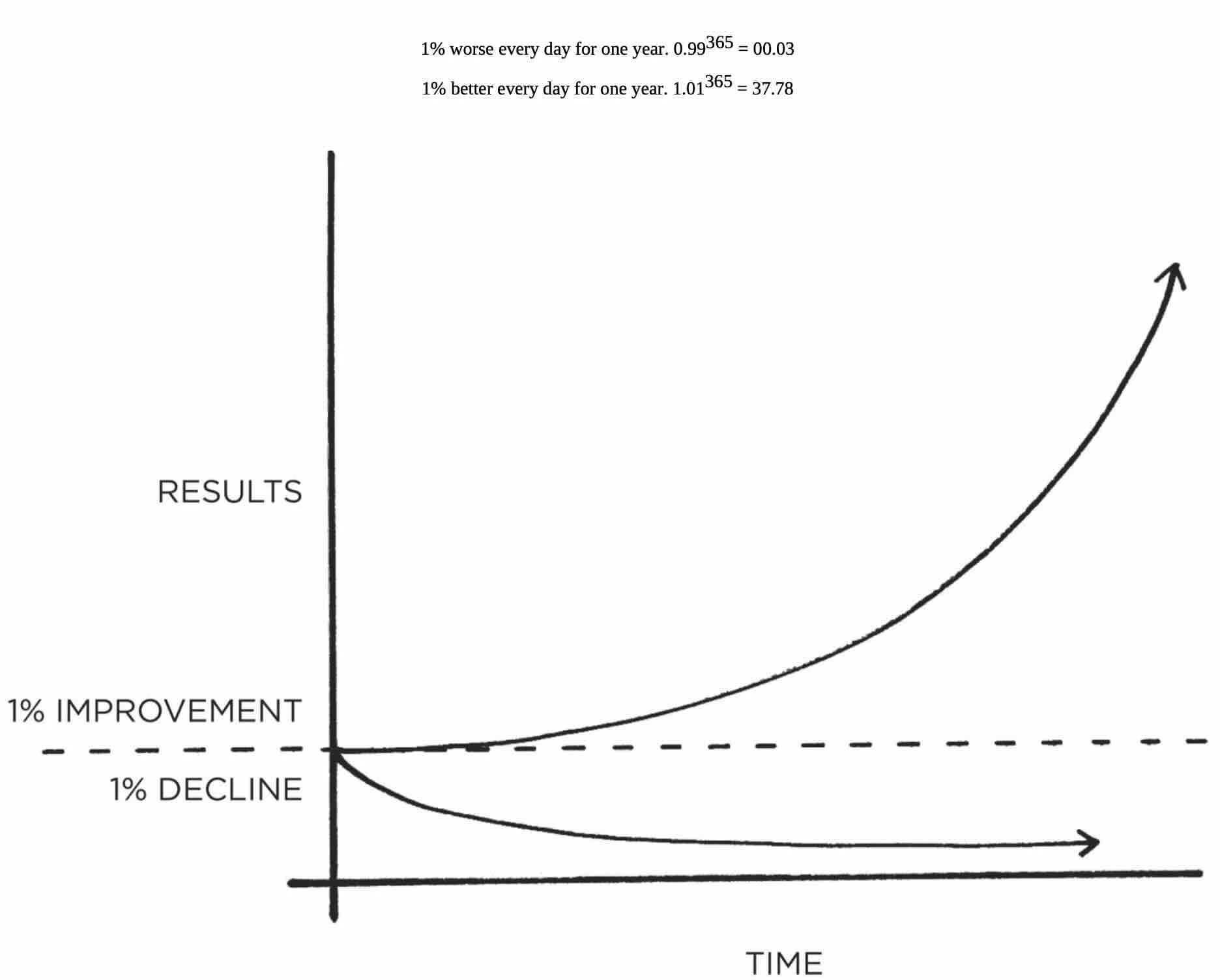
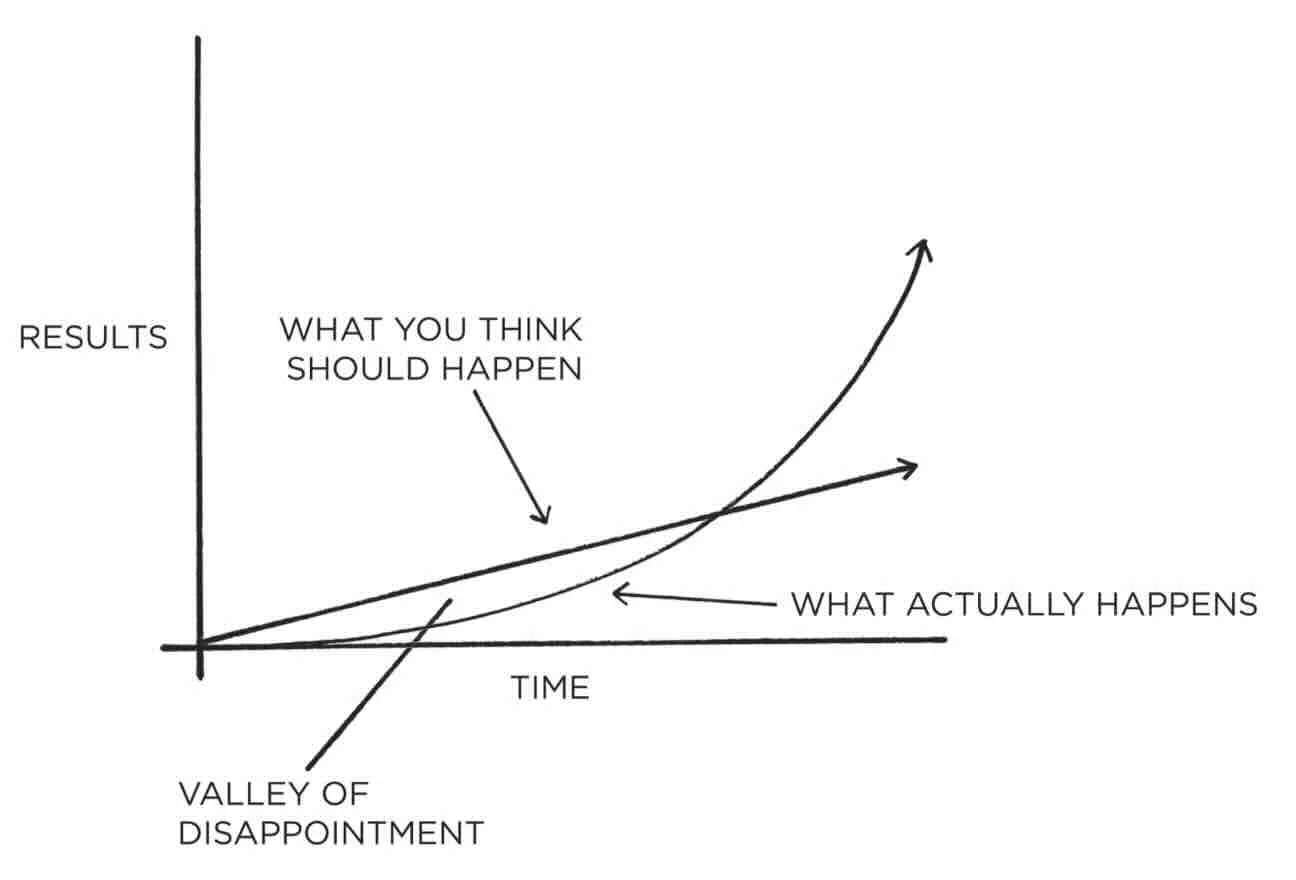
The impact of small habits is often not immediately apparent. Progress remains invisible during the “Plateau of Latent Potential”, the period where effort accumulates without visible results, until a critical threshold is crossed and breakthroughs happen suddenly. As the stonecutter analogy goes: “Yet at the hundred and first blow it will split in two, and I know it was not that last blow that did it, but all that had gone before.”
What truly matters is your current trajectory, not your current results. Outcomes are a lagging measure of habits; your net worth lags behind your financial habits, your weight lags behind your eating habits. Habits are a double-edged sword: they can compound for you (productivity, knowledge, relationships) or against you (stress, negative thinking).
-
Systems beat goals: Goals are about the results you want to achieve. Systems are about the processes that lead to those results. Winners and losers often share the same goals; what separates them is the system. “You do not rise to the level of your goals. You fall to the level of your systems.” True long-term thinking is “goal-less thinking”: an endless cycle of refinement and continuous improvement.
-
Identity drives lasting change: True behavior change is identity change. Instead of focusing on what you want to achieve (outcome-based goals) or what you need to do (process-based habits), the deepest change comes from focusing on who you wish to become. Your identity is your “repeated beingness”; every action is a vote for the type of person you wish to become. Each time you write a page, you are a writer. Each time you practice the violin, you are a musician. The more pride you have in an aspect of your identity, the more motivated you will be to maintain the associated habits.
-
The Four Laws of Behavior Change: Provide a practical framework for building good habits and breaking bad ones.
Make it obvious
Habits are often nonconscious and automatic. To improve them, first become aware of them using a “Habits Scorecard”: list daily behaviors and assess their long-term impact. Use implementation intentions (“I will [BEHAVIOR] at [TIME] in [LOCATION]”) and habit stacking (“After [CURRENT HABIT], I will [NEW HABIT]”). Design your environment so the cues for good habits are visible and accessible, and make cues for bad habits invisible.
Make it attractive
Habits are tied to dopamine: the anticipation of a reward, not its fulfillment, drives action. Use temptation bundling: pair an action you need to do with one you want to do. Leverage social influence by joining a culture where your desired behavior is the norm. Reframe your mindset: “I get to run” instead of “I have to run.”
Make it easy
The greater the friction, the less likely the habit. Human nature follows the law of least effort; design your environment to make desired actions the easiest path. Master the habit of showing up before worrying about perfection. The Two-Minute Rule: when starting a new habit, it should take less than two minutes to do. Use commitment devices to bind your future actions.
Make it satisfying
The brain prioritizes immediate pleasure. What is rewarded is repeated; what is punished is avoided. Use habit tracking to make progress visible and satisfying: the “Paper Clip Strategy” or crossing off calendar days creates streaks that motivate continued action. The critical rule: never miss twice. Missing once is an accident; missing twice is the start of a new habit.
- Additional insights: Genes predispose you to certain habits but don’t dictate destiny; find opportunities that match your personality. Desire is the gap between where you are and where you want to be; happiness is the absence of that desire. Repetition leads to physical changes in the brain; neurons that fire together wire together.
My Top 5 Takeaways
- Systems outperform goals over the long term
- Identity drives lasting change more than motivation
- Reduce friction instead of increasing discipline
- Consistency beats intensity
- Small improvements compound in every area of life
How I Apply These Ideas
Over time I’ve noticed this book changed how I think about improvement at work. The ideas went from interesting concepts to daily tools I rely on across engineering, leadership, and personal growth.
-
Systems over goals: Like Clear writes, winners and losers often have the same goals; the difference is the system. Rather than setting goals like “become a better architect”, I build systems that make improvement inevitable: reading technical books every morning, writing regularly about what I learn, documenting lessons after each project, experimenting with AI tools every week. The results follow from the process, not the intention.
-
Reducing friction for learning: The third law, “make it easy”, is one I apply every time I tackle a new technology. Before writing a single line of code, I prepare the environment: repository created, IDE configured, notes ready, reading list prepared. When starting is a matter of opening one file instead of setting up infrastructure, I stop finding excuses and start making progress.
-
Small improvements compound: Every week I learn something new, even if it’s small. A new framework, a language feature I overlooked, a tool that saves time. Alone each one feels insignificant. Over a few years the difference is enormous. This is the compound interest of self-improvement Clear describes, but applied to keeping skills current in a field that never stops moving. Rebuilding this website with Astro started as one of those small weekly explorations and grew into a complete transformation of the entire project.
-
Identity as a lever: When I stopped asking “how do I write more?” and started asking “what would someone who writes regularly do today?”, everything shifted. The question leads to action without pressure. It turns a goal into an identity. I’ve used the same reframing for mentoring, for code reviews, for showing up to difficult conversations. Each time I make the choice that matches who I want to be. It pairs well with Create Space, where the protected hour for reflection is the room that identity work needs.
-
Leadership is habit formation at scale: The same principles apply to teams. Culture is built through repeated behaviors, trust through repeated interactions, mentoring through repeated conversations, engineering excellence through repeated decisions. A leader who wants better outcomes doesn’t set bigger goals; they design better systems. That insight alone made this book more valuable to me than most leadership books I’ve read.
-
The 1% Rule: I applied this thinking directly at work. I created a team page titled “The 1% Rule” with one message: getting 1% better each day compounds into extraordinary results over a year, but it requires showing up consistently. The page lives in our team wiki and serves as a constant reminder that small daily improvements, not occasional heroics, drive lasting engineering excellence. It’s a practical artifact of Clear’s compounding principle, adapted for a software engineering context and shared openly with the team.
Favorite Quotes
- “You do not rise to the level of your goals. You fall to the level of your systems.”
- “Every action you take is a vote for the type of person you wish to become.”
- “The most effective way to change your habits is to focus not on what you want to achieve, but on who you wish to become.”
- “Until you make the unconscious conscious, it will direct your life and you will call it fate.”
- “The plateau of latent potential, it is only when looking back two, five, or perhaps ten years later that the value of good habits and the cost of bad ones becomes strikingly apparent.”
- “Professionals stick to the schedule; amateurs let life get in the way.”
- “When dopamine rises, so does our motivation to act. It is the anticipation of a reward, not the fulfillment of it, that gets us to take action.”
- “The goal is not to read a book; the goal is to become a reader.”
Who Should Read This Book?
Anyone who has ever set a goal and watched it fizzle out after a few weeks. Anyone who relies on motivation to get things done and wonders why it doesn’t last. Anyone (engineer, manager, writer, athlete, student) who wants to build systems that make improvement inevitable rather than accidental.
It’s particularly valuable for people in technical fields who appreciate frameworks and process thinking. The Four Laws give you an actionable system you can debug like code: if a habit isn’t sticking, which law is failing? Design the fix. Move on.
Final Verdict
What impresses me most about Atomic Habits is that it’s not really about productivity. It’s about designing your environment so the right behavior becomes the default. That shift, from relying on motivation to relying on systems, changed how I approach work, learning, and growth.
I’ve read it multiple times, and each read surfaces something new. The surface layer is habit formation. The deeper layers are systems and identity. That depth makes it worth revisiting.
I recommend it to everyone on my team and to anyone who asks about productivity. It’s not the last word on habits, no book is, but it’s the most practical starting point I know.