On this page
The Five Dysfunctions of a Team
 Ammar Najjar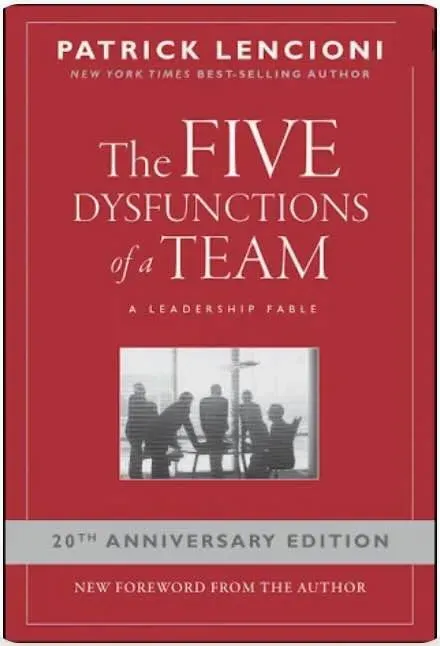
Patrick Lencioni, the American business consultant and founder of the Table Group, wrote The Five Dysfunctions of a Team as a leadership fable: a short novel that diagnoses why highly qualified groups so often underperform, told through the story of a struggling Silicon Valley startup and its new CEO. The book identifies five interlocking dysfunctions, absent trust, fear of conflict, lack of commitment, avoidance of accountability, and inattention to results, and argues that each one flows from the one beneath it.
The setup: DecisionTech and Kathryn Petersen
DecisionTech is a technology startup in California that looked like a sure thing: solid funding, talented developers, an experienced leadership team. Despite all of that, it has been losing customers and market share for years. When Kathryn Petersen takes over as CEO, she quickly identifies the real problem: it is not the product or the market. The management team is not aligned. Its members are actively trying to undercut each other.
This is a recognizable pattern. In team sports like basketball, a well-coordinated group of average players regularly outperforms a collection of egocentric stars, because the stars waste too much energy on internal power games. Those games damage morale and drive away the people who have finally had enough of the dysfunction. Kathryn decides that before she can fix DecisionTech’s business results, she has to fix its team dynamics. She puts teamwork ahead of the financial targets.
Dysfunction 1: Absence of trust
The foundation of Lencioni’s model is trust, and he is specific about what kind. It is not the ordinary professional trust of assuming colleagues will do their jobs. It is vulnerability-based trust: the willingness to show weakness, admit mistakes, and acknowledge uncertainty without expecting to be punished for it.
This kind of trust does not come naturally in competitive organizations. The default conditioning, reinforced early, is to protect your own position and conceal your limitations. Genuine trust requires the opposite: bringing your elbows in, overcoming the trained suspicion, and being willing to work with colleagues rather than against them.
At DecisionTech, the absence of trust is most visible in the management layer. The behavior there sets the tone for the entire organization. Until the leaders show that vulnerability is rewarded rather than exploited, nobody further down will risk it.
The Carlos episode illustrates what trust, once established, makes possible. When the sales director position comes open, Carlos, the head of customer service, puts himself forward as a candidate. The rest of the management team, emboldened by the culture Kathryn has been building, disagrees openly. Most of them believe someone else is more suitable, and they say so directly to Carlos. Carlos accepts the feedback without taking it personally. He understands that the criticism is about the role, not about him as a person, and that the team’s goal is simply to put the best qualified candidate in the job. This kind of exchange would have been unthinkable in the old DecisionTech culture.
Dysfunction 2: Fear of conflict
Trust creates the conditions for the second layer: productive conflict. And the first step toward such a culture has to come from the leaders. Kathryn knows this when she takes over as CEO of DecisionTech. She organizes a workshop about weaknesses, doubts, and mistakes. To give her people courage and break the ice, she leads by example: she speaks openly about her own shortcomings, tells them about management mistakes she made in the past, and even confides that she was fired from a previous job. The message is clear: vulnerability is rewarded here, not punished. The team starts to really get to know each other, not just as colleagues, but as people with strengths, edges, and rough corners.
Where trust is absent, meetings are polite and sterile. Nobody asks the questions that actually matter. There is no disagreement and no real debate, but there is also no movement. Difficult decisions get postponed or made in a watered-down form that satisfies no one and solves nothing. The surface is calm; the frustration is building.
Kathryn recognizes this pattern in DecisionTech’s leadership meetings. The atmosphere is civil but nothing gets resolved. She deliberately works to build a different conflict culture, one in which disagreement is expected and valued rather than avoided. The message she conveys is that the point of discussion is not for everyone to agree; it is to challenge each other toward better solutions. Over time the team starts bringing difficult topics to the table, debating them seriously, occasionally getting heated, but always treating each other with respect. The goal shifts from avoiding friction to using it productively.
This is the chain: trust makes people willing to be vulnerable, and vulnerability is what makes genuine debate possible. Without vulnerability, conflict feels too dangerous. With it, conflict becomes the mechanism through which better decisions get made.
Dysfunction 3: Lack of commitment
Better decisions still need to be followed through. This is where the third dysfunction appears: lack of commitment. In dysfunctional teams, decisions get made in meetings and then quietly undermined, postponed, or relitigated afterward. Contradictory signals go out to the rest of the organization. Nobody is sure what has actually been decided or whether it will stick. The resulting confusion is demotivating and spreads through the company.
Kathryn encounters this at DecisionTech repeatedly. The leadership team hedges, delays, and undercuts decisions even after they have nominally been agreed. She works to clarify what commitment actually means in a group context: consensus does not mean that everyone is completely satisfied with the outcome. If it did, every decision would be so heavily compromised that it would lose its effect. Consensus means that everyone is willing to carry a decision forward, even if they argued for something different before it was made. The prerequisite for this is that every voice has genuinely been heard. When people feel their perspective has been taken seriously, most are willing to set aside their individual preference and support the collective decision. They are willing to put the project ahead of their ego.
Dysfunction 4: Avoidance of accountability
Commitment alone is not enough if nobody holds anyone to it. The fourth dysfunction is the reluctance to call out colleagues when they fall short. Teams that are otherwise functioning well, that have good relationships and a positive atmosphere, are particularly prone to this: members avoid confronting friends and well-liked colleagues because they do not want to damage the relationship or seem presumptuous.
A concrete example from DecisionTech: one team member misses a deadline for an analysis that the rest of the group is depending on. The team notices in time to address it but says nothing. Nobody wants to be the person who calls it out. Kathryn responds by calling a meeting and naming the dynamic directly. She explains that by staying silent the team has not protected anyone; it has accepted the failure collectively. Staying quiet is not kindness; it is a passive contribution to the problem.
Peer accountability, done right, is the opposite of a relationship threat. It is a sign of respect: you take your colleagues seriously, you believe they are capable, and you expect them to deliver. When feedback comes from a peer rather than a manager, it signals genuine equality, not hierarchy. Teams that hold each other accountable hold themselves to a higher standard and avoid drifting into mediocrity.
Dysfunction 5: Inattention to results
Even teams that have worked through the first four dysfunctions can fail at the fifth: orienting collective effort toward shared results rather than individual interests. Kathryn’s husband is a basketball coach who at one point has to drop his most talented player from the roster. The player is exceptional by individual measures, but he cares only about his own scoring and is indifferent to whether the team wins or loses. With him on the floor, the team’s collective performance suffers. The coach has no choice.
The same thing happens in companies when individuals prioritize their own career advancement over the shared goal. Communication fades, people stop investing in each other, and the best performers eventually leave for environments where real teamwork exists.
Lencioni’s prescription is to make the shared goal concrete and unambiguous. At DecisionTech, Kathryn sets a specific objective: 18 new large customers by year-end. No qualifications, no interpretation required. That target becomes a unifying point. The technical team starts helping the marketing team prepare product presentations for the sales effort, because everyone understands that success means the company hitting its number, not any individual department looking good. Like a rowing crew that must synchronize every stroke to win, the team’s movements need to be coordinated; that coordination does not emerge from a memo but from time spent together.
Kathryn institutionalizes that time. She introduces fixed formats: weekly team meetings, quarterly strategy sessions, and a commitment of eight full days per quarter in which the leadership group deliberately invests in its own functioning. The results are measurable: team members understand each other better, trust and discussion quality both improve, responsibilities are clearer, duplication decreases, and changes are communicated transparently to the whole organization rather than silently dropped into calendars.
Verdict
The Five Dysfunctions of a Team is most effective as a diagnostic tool: the five-layer model is simple enough to hold in mind during a meeting and precise enough to identify exactly which layer is causing a specific team’s problems. The fable format keeps it readable without diluting the framework. Lencioni’s insight that the dysfunctions are sequential, that you cannot fix commitment before you fix conflict, and cannot fix conflict before you fix trust, is genuinely useful for understanding why piecemeal team-building interventions so often fail. The book is short enough to read in a sitting and specific enough to act on immediately. Worth reading for any manager or team lead who recognizes the DecisionTech pattern in their own organization.
Have you recognized the DecisionTech pattern in a team you’ve worked with?
Drop a comment below; I read every one.