On this page
- Two minds in one head
- Cognitive ease: why familiar feels true
- When fast thinking stumbles: the bat and the ball
- The shortcuts: heuristics and how they fool us
- Priming: how the world nudges us without asking
- The stories we tell ourselves: WYSIATI, halo, and confirmation
- Overconfidence: knowing things you don’t
- Money, risk, and the way we frame choices
- Why we’re so bad at statistics
- Planning and optimism: the trouble with the future
- How we remember: peaks, endings, and two selves
- Noise, bias, and what to do with the book
- Quotes to carry with you
- How I Apply These Ideas
- Verdict
Thinking, Fast and Slow
 Ammar Najjar · Posted on August 8, 2026 · 14 min readself-improvement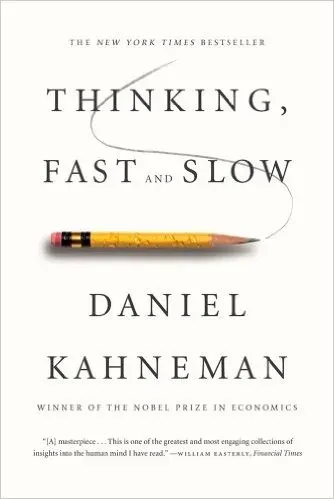
Daniel Kahneman, the psychologist who won the Nobel Prize in Economic Sciences in 2002, spent a lifetime of research, much of it with his longtime collaborator Amos Tversky, studying how the human mind makes decisions. Thinking, Fast and Slow distills that research into a tour of our cognitive machinery and gives us a language to talk about why so much of our reasoning is quietly driven by bias. The central claim: human judgment is predictably imperfect, and once you understand the shortcuts your mind is taking, you can start catching them.
Two minds in one head
The book’s organizing idea is deceptively simple: imagine two systems. System 1 is the automatic mind. It is fast, intuitive, emotional, and constantly active. It reads simple words, detects anger in a face, completes the phrase “bread and…” without effort, and drives a familiar route while your attention is somewhere else. System 2 is the deliberate mind. It is slow, logical, effortful, and demands attention. It is what you use to solve 27 × 46, learn a new programming language, compare mortgage offers, or review a legal contract. System 2 is who we think we are; it articulates judgments and makes choices. But it is not always a beacon of rationality. Making a conscious effort to think does not guarantee you are right.
Both systems are always working, yet System 1 almost always guides our thoughts and actions, usually quite accurately. At its core sits associative memory, and that matters: we tend to believe the story we make up, which leads to overconfidence and to overrating how well we grasp a situation.
Cognitive ease: why familiar feels true
System 2 usually operates in low-effort mode. It follows the law of least effort; it is lazy. Most of our thinking costs little energy, which is exactly why System 1 keeps the upper hand. When a question or problem arrives, System 1 tries to supply the answer first, and only when it fails does System 2 get engaged.
Kahneman distinguishes two states of mind: cognitive ease and cognitive strain. We experience ease when we read something in a clear font, when we are in a good mood, or when something has been repeated to us. We experience strain when we are in a bad mood, when text is faint or printed in a complicated font, or when something is poorly worded. Because ease feels good, we often judge something as true simply because it feels familiar, because we can recall it with cognitive ease. That is why repeating a simplistic message works: political slogans get believed partly because they are repeated, which Kahneman suggests helps explain why extremist political groups still hold so much influence over people.
When fast thinking stumbles: the bat and the ball
The clearest proof that System 1 can be confidently wrong comes from problems designed to trigger it. Consider the classic bat and ball problem: suppose a bat and a ball cost $1.10 together, and the bat costs one dollar more than the ball. How much does the ball cost?
Most people answer ten cents. Intuitive, quick, and wrong. If the ball cost ten cents, the bat would cost $1.10 and the total would be $1.20. The correct answer is five cents. The same failure shows up in optical illusions: the wrong answer arrives confidently, and we do not realize we have been misled.
The shortcuts: heuristics and how they fool us
System 1 leans on heuristics, mental shortcuts that are usually efficient but create predictable mistakes. The most important involves substituting a difficult question with an easier one, automatically. Asked “How should financial advisers who prey on the elderly be punished?”, your brain quietly rewrites the question as “How much anger do I feel thinking of financial predators?” and then uses intensity matching to scale the punishment to the anger. The danger: because an answer comes so readily, we often fail to recognize a complex problem as complex.
Availability heuristics skew our sense of frequency. We judge how likely something is by how easily examples come to mind, so media coverage of a plane crash makes flying feel dangerous for a while, even though driving remains statistically far more dangerous. We also trust our own experiences more than reports from elsewhere.
Representativeness heuristics make us judge by similarity instead of probability. The famous Linda problem, designed by Kahneman and Tversky: Linda is intelligent, outspoken, and concerned with social justice. Which is more likely, that Linda is a bank teller, or that Linda is a bank teller and active in the feminist movement? Most people choose the second, but it violates probability: a subset can never be more likely than the whole set it belongs to. This is the conjunction fallacy.
Anchoring warps the numbers we produce. The first figure we encounter shapes the estimates that follow, whether in salary negotiations, house prices, discounts, or car purchases. Even absurd anchors work: people asked whether Gandhi lived longer than 140 years guess higher ages than people asked whether he lived longer than 9 years.
Affect heuristics, coined by psychologist Paul Slovic, let our likes and dislikes determine our beliefs about the world. If we like someone, we believe they are smarter, trust them more, and rate their ideas more highly; if we dislike someone, the opposite happens. Our emotions quietly steer how we see political topics and, indeed, most of our lives.
Priming: how the world nudges us without asking
Priming shows how deeply our actions are shaped by things we never notice. Complete the word SO_P, and your answer shifts from SOUP to SOAP depending on whether you just heard the word EAT or the word WASH; we retrieve words connected to other words more easily. The same holds for concepts and ideas. When we are smiling, we find things funnier, and studies have shown that people who vote in a school building tend to favor education issues.
Kahneman draws a sobering conclusion for society: living in a money-focused culture primes us toward individualism. The culture we inhabit shapes how we conduct our lives, largely without our noticing.
The stories we tell ourselves: WYSIATI, halo, and confirmation
WYSIATI, which stands for What You See Is All There Is, is one of Kahneman’s most important concepts. System 1 builds a coherent story from incomplete information and rarely asks what is missing. Someone arrives late twice, and System 1 concludes they are irresponsible, ignoring the sick child, the traffic accident, or the broken train.
The halo effect does something similar for people. One positive trait colors everything else: beautiful people are judged smarter, kinder, and more competent, and a charismatic CEO is assumed to be an excellent strategist. It influences hiring, promotions, politics, and investing. We form an impression in the first seconds of meeting someone, based on their looks or their voice, and then value that first impression far more than anything we learn later, even though the order in which we perceive a person’s traits is often pure chance.
Confirmation bias finishes the job. We seek evidence that supports our beliefs and ignore what contradicts them. Instead of asking “Am I right?”, we ask “How can I prove I’m right?”. Kahneman’s prescription: good thinking means actively hunting for disconfirming evidence.
Overconfidence: knowing things you don’t
We are far more confident than accurate. Hindsight bias makes past outcomes seem obvious once they have happened, the “I knew it all along” feeling that produces false confidence in our judgment. The illusion of understanding works the same way in reverse: after a company succeeds, we construct a clean story of why it was inevitable, even though very few people predicted it beforehand. And in complex environments, expert prediction is barely better than chance; political forecasting is a good example. Confidence is often unrelated to accuracy.
Money, risk, and the way we frame choices
Kahneman’s prospect theory changed economics by introducing a reference point: we evaluate outcomes as gains and losses relative to where we start, not in absolute terms. Losses loom larger than gains. Losing €100 feels much worse than finding €100 feels good, roughly twice as bad, which explains why we hold losing investments, resist change, buy insurance, and negotiate badly.
Framing decides which option looks attractive. Presented with a sure gain of €900 or a 90% chance of winning €1,000, most people take the guaranteed €900. Presented with a sure loss of €900 or a 90% chance of losing €1,000, most people gamble. Same economics, different frame, and we become risk-seeking the moment losses appear.
Framing leaks into everything, including medicine. Treatment A saves 90 out of 100 patients; Treatment B has a 10% mortality rate. The information is identical, the emotional response is not.
The sunk cost fallacy is the same bias pointed backward: past investments keep influencing current decisions. We watch a bad movie because we bought the ticket, keep funding a failing project, and stay in losing positions. The rational question Kahneman suggests asking: what would I choose if I were starting today?
Why we’re so bad at statistics
Availability heuristics already make frequency estimates unreliable; statistics give our minds even more room to wander. Base rate neglect: told that most students at a university study humanities, people answer accordingly, until a description clashes with their stereotype, at which point they ignore the base rate and jump to a causal story. The classic version: a quiet man who enjoys reading is more likely to be a farmer than a librarian when there are 100 farmers for every librarian, yet the description outweighs the probability in our heads.
Denominator neglect changes the same risk depending on how it is expressed. “A vaccine that protects children from a fatal disease carries a 0.001% risk of permanent disability” sounds acceptable. “One out of every 100,000 vaccinated children will be permanently disabled” conjures the image of a disabled child and feels far worse. Kahneman points out: “Low probability events are much more heavily weighted when described in terms of relative frequencies (how many) than when stated in more abstract terms of ‘chances,’ ‘risk,’ or ‘probability’ (how likely).”
Regression to the mean explains a great deal of false cause and effect. Extreme performances drift back toward average on their own: an athlete’s exceptional day is usually followed by a more ordinary one, and we wrongly credit praise, criticism, or motivation for what is simply a statistical effect.
Planning and optimism: the trouble with the future
Two closely related biases sabotage plans. The planning fallacy has us systematically underestimating time, cost, and difficulty; software projects are the classic example. Instead of consulting historical evidence, we imagine the ideal scenario. Kahneman recommends the outside view: ask how long similar projects actually took. The optimism bias, meanwhile, is the comforting conviction that it will work out. It fuels innovation, but it also produces unrealistic schedules, startup failures, excessive debt, and overinvestment.
How we remember: peaks, endings, and two selves
Our memory distorts experience, and Kahneman demonstrates it with an experiment from the 1990s. Colonoscopy patients rated their pain during the procedure and again afterwards. Patient A had a short procedure that ended painfully; Patient B had a longer one that ended less painfully. Both rated the pain they felt during the procedure as similar, yet afterwards Patient A reported the worse overall experience, despite the shorter procedure.
The peak-end rule explains it: we remember experiences mainly by their emotional peak and their ending, not by their average. Duration neglect follows: how long an experience lasted barely affects how we judge it. We carry two selves, the experiencing self that lives in the moment and the remembering self that writes the story afterwards. A vacation can be enjoyable throughout and end badly, and the remembering self judges the entire trip by that ending. Since we make decisions from remembered experience, our distorted memory quietly steers future choices.
Noise, bias, and what to do with the book
Kahneman closes by separating two kinds of error. Bias is a consistent deviation in one direction; noise is random inconsistency. Two judges handing down different sentences for identical crimes is noise. Improving judgment means reducing both.
He offers practical habits. Slow down for important decisions and ask: what assumptions am I making, what evidence contradicts my conclusion, and am I relying on intuition where analysis is needed? For investing, avoid panic selling, chasing trends, recent-news bias, and overconfidence, and focus on probabilities rather than stories. For management, estimate projects using historical data, encourage dissenting opinions, and separate evidence from confidence. For negotiations, be aware of the anchor; the first number discussed often shapes the rest of the conversation. In everyday life, recognize when emotions are driving a decision, remember that first impressions are incomplete, and question obvious explanations.
Quotes to carry with you
Three ideas from the book linger longer than the rest:
- The focusing illusion: “Nothing in life is as important as you think it is while you are thinking about it.”
- The confidence trap: “The confidence people have in their beliefs is not a measure of the quality of evidence but of the coherence of the story they have constructed.”
- Loss aversion: “Losses loom larger than gains.”
How I Apply These Ideas
A book about how judgment fails is most useful where judgment gets exercised daily: debugging, estimating, reviewing, and deciding what to keep or cut.
-
Catch your System 1 in the act: When a fix comes to me instantly, the answer usually came from System 1, and quick answers in a codebase feel right and are not. So I write the test first and let it prove the obvious answer wrong before I trust it.
-
Estimate with the outside view: The planning fallacy is the software industry’s default setting. Instead of imagining the ideal scenario, I now ask how long the last three similar tasks actually took, and plan from that number rather than the dream version.
-
Hunt for disconfirming evidence: Confirmation bias is why debugging takes so long when you are sure you found the cause. When a hypothesis feels airtight, I spend the first minutes looking for evidence it is wrong, and in code review I look for reasons the change is wrong rather than reasons it is fine.
-
Watch the anchor: The first figure in any conversation sets the range. I have learned to notice when someone else drops an anchor and to lay down a defensible one myself before the other side sets the frame.
-
Kill the sunk cost: Loss aversion and sunk costs are why dead projects stay alive. “What would I choose if I were starting today?” is now my default test for tools and unfinished work, which is also why my local AI post is honest about what to skip.
-
Write for cognitive ease: Unclear writing actively misleads, because ease is mistaken for truth. I rewrite titles, intros, and commit messages until they read easily, which is exactly what this blog is for.
Verdict
Thinking, Fast and Slow is not a self-help book; it is a map of the machinery. Kahneman’s goal is not to eliminate intuition, which is remarkably effective in familiar situations, but to teach us to recognize the situations where it lies, forecasting, risk, money, and complex plans, and to switch on System 2 precisely when it matters. It is dense, occasionally demanding, and studded with experiments you will not forget, the bat and the ball, Linda, the colonoscopy. If you have ever wondered how your own mind works, this is the book to start with.
Have you caught your own System 1 falling for the bat and ball problem?
Drop a comment below; I read every one.